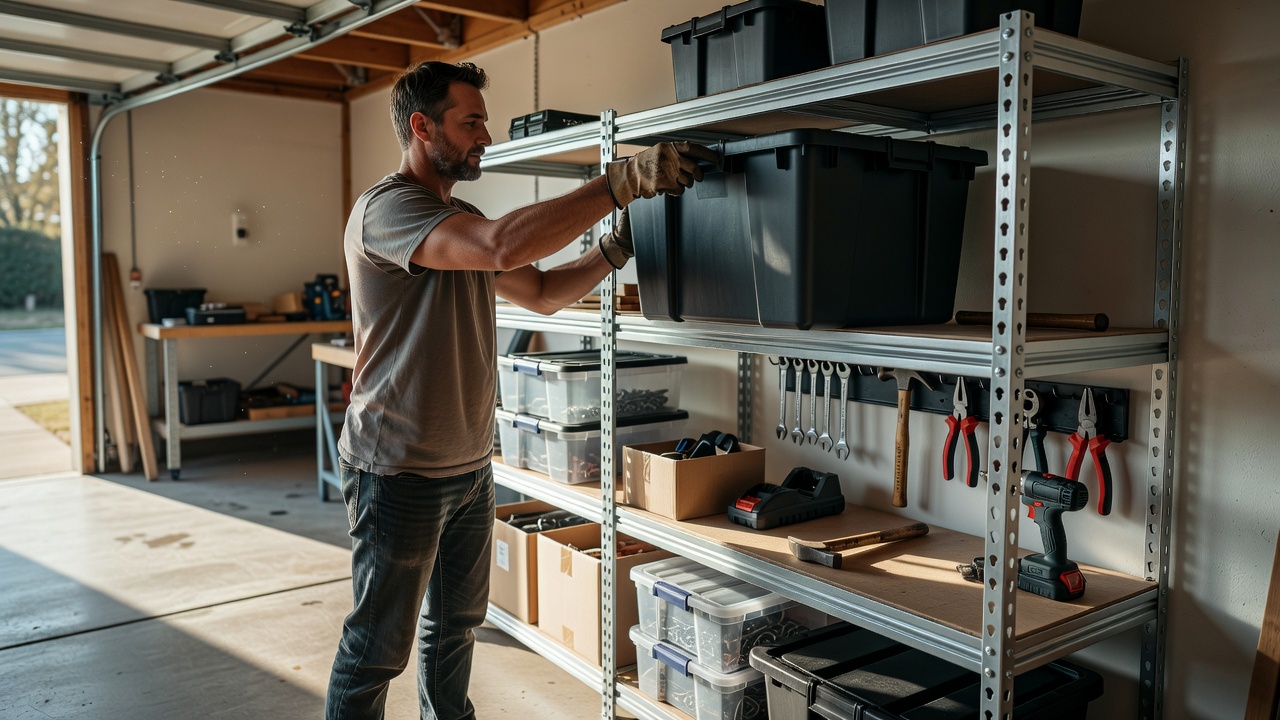
Utility storage has to accommodate objects that were not designed to stack neatly: folded ladders, muddy boots, extension leads, tool cases and half-used decorating supplies. Before comparing racks, divide those belongings by what they need. Some need dry conditions, some need ventilation, and some must remain inaccessible to children. Treating all of them as identical boxes creates a tidy-looking arrangement with hidden risks.
We compare storage formats rather than claim hands-on testing of a particular rack. Product specifications change, and load figures are conditional. Check the current manual for the complete configuration you intend to build. If a retailer summary disagrees with the manufacturer’s instructions, resolve that discrepancy before purchase or installation.
Map the footprint with the contents in place
Measure the rack’s overall width and depth, including feet and projecting brackets. Then measure the largest actual container, not just the size printed on its packaging. Lids, handles and tapered sides often affect how a tote fits. A container may sit on a shelf yet still be impossible to pull out when the next shelf is too close above it.
Mark the footprint on the floor with removable tape. Walk past carrying a laundry basket or tool case. Open the garage door, vehicle door and utility cupboard fully. Leave access to electrical equipment, shut-off points and essential building services. If the proposed shelf creates a narrow turn or blocks an exit, reduce its depth or change location rather than hoping careful use will make up for the obstruction.
Freestanding racks: useful capacity, real assembly demands
Boltless metal racks and adjustable utility shelves can provide broad storage bays without separate brackets for each shelf. They suit grouped tools, household supplies and manageable seasonal containers. Their limitations often appear in the details: shelf panels may respond poorly to damp, feet may need suitable support, and adjustable sections must be fully seated.
Look for both shelf-level and whole-unit limits. A stated evenly distributed load is not the same as the same weight concentrated under a small machine. Keep heavier items lower, avoid unstable piles and follow restraint requirements. Do not climb the rack or use a shelf as a work platform. Level and assemble the unit only as instructed; improvised packing or removed braces can undermine its intended performance.
Modular systems: flexibility with a compatibility cost
Systems such as IKEA BROR and Elfa illustrate different ways to organize a changing utility area. The useful question is not whether a system has many accessories, but whether its shelf spacing, baskets and hooks match the equipment you own. Count the components required for the complete layout, including supports, connectors and any specified restraints.
Modularity also creates a future-dependence trade-off. Accessories from another range may look compatible but have different attachment details. Keep the assembly manual and model information so later additions can be checked properly. Do not mix load-bearing components unless the manufacturer explicitly permits the combination. Start with the equipment you use each week, then add storage only where the routine shows a real gap.
| Format | Best everyday use | Main compromise |
|---|---|---|
| Freestanding rack | Grouped containers and tool cases | Occupies floor area; assembly and restraint matter |
| Modular system | Changing mix of shelves and accessories | Component cost and compatibility |
| Wall rail or hooks | Awkward tools that need individual access | Suitable wall, fixing and projection required |
Wall storage: free floor space without creating hazards
A dedicated hook can be better than a deep shelf for a long-handled tool. Check that the support retains the object securely and that handles do not project into a walking route. Bikes, ladders and bulky garden equipment need supports designed for their shape and weight, fixed into suitable structure. Keep sharp or hazardous equipment out of children’s reach and secure it appropriately.
Overhead storage deserves particular caution. A ceiling is not automatically suitable for a suspended load, and a garage door mechanism may occupy space that looks empty when closed. Use a system intended for the application and get competent advice where structural capacity or installation is uncertain. A clear floor is not worth an unsafe overhead load.
Keep materials in the right environment
Follow the original labels for paints, chemicals, batteries and fuels. Do not decant hazardous substances into food containers or group incompatible products merely because they fit the same bin. Temperature, moisture and ventilation requirements may rule out a garage entirely. Local fire and waste authorities can advise on storage restrictions and disposal; the U.S. Fire Administration and your local fire service are useful starting points for fire-safety information.
What should I check after assembly?
Confirm all specified braces, fasteners, shelf clips and restraints are fitted. Check stability using the manufacturer’s procedure, load gradually within the stated limits and stop using the unit if it develops damage, unusual movement or sagging.
Label the retrieval job, not just the contents
“Bike repair” is often more useful than “miscellaneous tools.” Store the items needed for a task together without making the container too heavy to handle comfortably. Keep frequently used equipment within an easy reach range for its users. Seasonal items can sit farther away, but they still need a safe retrieval plan. A short check for damp, damage and blocked routes will do more for the system than another matching set of boxes.
For smaller indoor gaps, use the same access-first approach in our small-space guide.