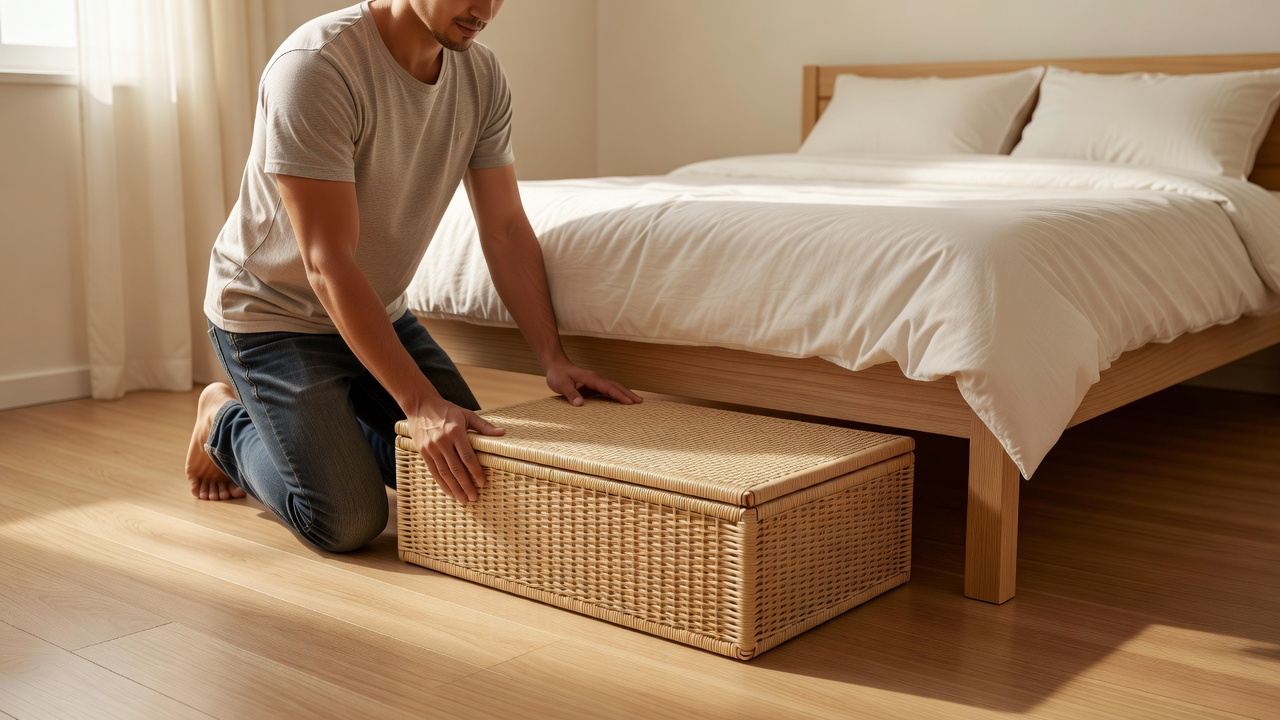
Compact homes make every storage decision visible. A deeper cabinet may swallow more belongings while making the route past it irritating all day. A small organizer can be genuinely useful if it removes a repeated detour. Judge the change by the routine it improves, not by how much additional volume you can claim.
Begin with one awkward moment: a bag dropped in the doorway, spare bedding trapped behind a bed frame or shoes blocking a cupboard. Observe where the item naturally lands and what prevents it from going back. These notes will tell you more than a room full of new containers. The aim is less daily negotiation, not a permanently immaculate home.
Build a landing zone along the real route
A landing zone should intercept belongings before they reach the nearest chair. A shallow tray for keys, a secure hook for a bag and a small place for incoming post may be enough. Position them where the household actually pauses. Storage placed beyond the kitchen or up the stairs is unlikely to catch items dropped just inside the front door.
Keep the collection finite. A tray that becomes an archive needs a simple exit route for recycling, filing or returning things elsewhere. Avoid projecting hooks at face height or narrowing a passage. In a rented home, check permission for fixings and the suitability of the surface. Removable adhesive is not a guarantee against paint damage or a substitute for a load-rated installation.
Under the bed: measure more than height
Measure below the lowest rail, then look for centre legs and other obstructions. Include container wheels, lid clips and any flex in soft-sided bags. Check the floor surface too: a wheel that rolls well on a smooth shop floor may be frustrating on thick carpet. A handle should remain reachable when the container is fully stored.
Now test the retrieval space beside the bed. If a bedside cabinet must move before every opening, reserve that position for genuinely infrequent items or choose a different format. Protect textiles from dust and damp while following relevant fabric and bed-base guidance. Avoid packing belongings against surfaces that need airflow, and do not block ventilation openings or heating equipment.
Low rigid boxes provide clear boundaries but need a matching gap and enough room to remove the lid. Zipped fabric bags can conform to an awkward space, although they are less convenient when contents change often. Neither format compensates for moisture problems. Investigate damp rather than sealing vulnerable belongings into a container and hoping for the best.
Door storage: check the whole swing
Over-door racks can use an overlooked surface without drilling, but “no drilling” does not mean “no constraints.” Check the thickness of the door, the top clearance, the hook padding and the rack’s rated use. Test whether the door closes and latches normally with the rack empty before adding any contents.
Do not modify fire doors, compromise door closers or obstruct an escape route. A rack that clashes with a wall, mirror or adjacent cabinet is not a successful use of space. Keep heavy items and anything hazardous in storage suitable for their risks. For bathroom doors, consider ventilation, moisture and whether the door can still open comfortably for everyone using the room.
| Option | Useful for | Movement to allow |
|---|---|---|
| Under-bed box | Spare bedding and seasonal clothes | Full pull-out distance and lid opening |
| Door rack | Light, frequently used items | Full door swing and closing clearance |
| Storage bench | One clear category near a routine | Lid or drawer opening without moving furniture |
| Narrow trolley | A defined task in a suitable gap | Handle access, wheel travel and safe parking |
Ask multipurpose furniture to do both jobs well
A storage bench has to be a safe, comfortable seat and accessible storage. Check the seating rating separately from the internal storage capacity. Look at lid supports, pinch points and the manufacturer’s suitability guidance, especially around children. Never treat a storage chest as a toy box unless it is intended and suitable for that use.
A lift-up coffee table can help in a compact living room, but it may trap the very things needed when the surface is covered. Rehearse an ordinary evening: cups on top, someone seated nearby, a blanket inside. If accessing the blanket requires clearing the whole table, a nearby basket may be the simpler solution.
Do not spend every inch
A narrow rolling trolley can work for a defined task, provided it stays stable, fits the environment and does not sit near heat or block appliance ventilation. Follow appliance clearance requirements rather than filling a gap simply because a trolley fits. Check that small children cannot use a movable unit to reach hazards.
How can I test an idea before buying?
Use cardboard to model the full size and tape to mark the footprint. Rehearse doors, drawers and retrieval using a representative object. Keep the mock-up clear of exits, heaters and ventilation. A quick test can reveal a movement problem that dimensions alone miss.
Leave some space deliberately empty. A clear corner for turning with a laundry basket or setting down shopping can be more valuable than another storage tower. Review the change after ordinary use: if the item returns to its old pile, adjust the access or location before blaming anyone’s tidiness. For heavy or bulky belongings, see utility storage planning.